Aquarium Heater Size Calculator: What Size Heater Do I Need?
Calculate the appropriate heater wattage for your aquarium based on your tank size and desired temperature increase.
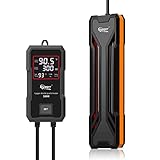
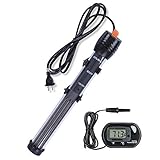
List of the Best Aquarium Heaters:



How to Size an Aquarium Heater (Wattage by ΔT)
The right heater wattage depends less on tank volume than on ΔT — the difference between the room temperature and the target water temperature. A 55-gallon tank in a 68°F home needs ~250 W to hold 78°F; the same tank in a 55°F garage needs ~700 W. This guide gives the ΔT-based wattage formula, the location and cover multipliers, the two-heater failsafe, and the electrical safety features that matter more than any spec.
The Wattage Formula
ΔT = desired_water_temp − room_temperature

watts_needed = tank_gallons × watts_per_gallon_factor
               × location_multiplier
               × cover_multiplier
Watts-per-gallon factor (the dominant variable):
| ΔT (°F) | Watts per gallon | Typical scenario |
|---|---|---|
| ≤ 10 | 3–5 W/gal | Warm room, well-insulated tank |
| 10–15 | 5–7 W/gal | Standard indoor home in winter |
| 15–20 | 7–10 W/gal | Cool room, garage, or drafty space |
| > 20 | 10+ W/gal | Cold garage, outdoor, or unheated space |
Location multiplier: Indoor ×1.0; Garage/semi-heated ×1.2–1.4; Outdoor ×1.5–2.0. Cover multiplier: Full cover ×1.0; Partial ×1.1–1.2; No cover ×1.3. These multipliers compound with the ΔT factor — a cold garage with an uncovered tank can require 3–4× the wattage of a warm indoor tank of the same volume.
Worked Examples
Example 1 — 55 gal indoor, 68°F room, 78°F target, full cover:
ΔT = 78 − 68 = 10°F → 5 W/gal
watts = 55 × 5 × 1.0 × 1.0 = 275 W
→ 250 W or 300 W heater
Example 2 — 55 gal garage, 55°F, 78°F target, no cover:
ΔT = 78 − 55 = 23°F → 10+ W/gal
watts = 55 × 10 × 1.3 (garage) × 1.3 (no cover) = 929 W
→ two 500 W heaters (failsafe; see below)
Example 3 — 20 gal indoor, 68°F, 78°F target, full cover:
ΔT = 10°F → 5 W/gal
watts = 20 × 5 × 1.0 × 1.0 = 100 W
→ 100 W heater
Failsafe — Why Two Heaters Beat One
Aquarium heaters have a well-documented failure mode: a stuck thermostat that heats continuously until the tank is over 100°F, or an open circuit that silently stops heating. Both kill fish, and both are more common than most hobbyists realize. The practical mitigation is two smaller heaters instead of one larger one, each rated for ~50% of the required wattage:
- If one heater fails "on": at 50% of the required wattage, its failure heats the tank slowly and does not cook the fish. The other heater continues to regulate via its own thermostat.
- If one heater fails "off": the tank can be maintained at target by the remaining 50% in most cases, or drops slowly enough that the hobbyist can notice and act.
- Distribution: two heaters placed at opposite ends also improve temperature uniformity in long tanks.
For tanks over 40 gallons, two heaters at 50% capacity is the standard recommendation. For tanks under 20 gallons, a single small heater is fine — the failure thermal mass is small enough that the hobbyist can intervene. Between 20 and 40 gallons, judgment depends on stock value; the failsafe cost is modest.
Location and Cover Multipliers
| Factor | Multiplier | Notes |
|---|---|---|
| Indoor, temperature-controlled room | ×1.0 | Baseline |
| Garage / semi-heated space | ×1.2–1.4 | Room temperature swings more |
| Outdoor / unheated space | ×1.5–2.0 | Especially winter; wind exposure adds |
| Full cover / hood | ×1.0 | Reduces evaporation and heat loss |
| Partial cover | ×1.1–1.2 | Open top areas lose heat |
| No cover | ×1.3 | Evaporative cooling is significant |
Quick Reference — Typical Wattage by Tank Size
| Tank size | ΔT ≤ 10°F | ΔT 10–15°F | ΔT 15–20°F |
|---|---|---|---|
| 5 gal | 25 W | 30–40 W | 50 W |
| 10 gal | 50 W | 50–75 W | 75–100 W |
| 20 gal | 100 W | 100–150 W | 150–200 W |
| 29 gal | 150 W | 150–200 W | 200–300 W |
| 55 gal | 250 W | 275–385 W | 400–500 W |
| 75 gal | 375 W | 375–525 W | 525–750 W |
| 125 gal | 625 W | 625–875 W | 875–1,250 W |
For ΔT above 20°F, apply the 10+ W/gal factor and the appropriate location/cover multipliers — the figures can be 2–4× the table values. For tanks over 40 gal, split the total into two heaters at 50% each for the failsafe.
Temperature Requirements by Fish Type
| Group | Range (°F) | Notes |
|---|---|---|
| Tropical community | 75–80 | Tetras, guppies, mollies, platies |
| Tropical cichlids | 76–82 | Angels, African cichlids; discus 82–86 |
| Coldwater | 65–72 | Goldfish, white cloud minnows; no heater needed in warm rooms |
| Bottom dwellers | 75–81 | Corydoras, loaches, most plecos |
| Brackish | 75–82 | Mollies, monos, archer fish |
| Discus | 82–86 | Highest tropical range; needs dedicated heater |
Electrical Safety — What Actually Matters
- UL or equivalent listing: A heater that has passed UL 197 (or ETL / CSA) has been tested for immersion safety, electrical isolation, and thermostat fail-safe behavior. Non-listed imports vary widely; the price difference is small relative to the risk.
- GFCI outlet: A GFCI-protected circuit trips at ~5 mA of leakage — before a shock becomes dangerous. All aquarium circuits should be GFCI. This is the single highest-value electrical safety improvement.
- Shatterproof / titanium housing: Glass heaters can break from thermal shock or physical impact. Titanium or shatterproof plastic housings are safer options, especially in tanks with large or boisterous fish.
- Heater guard: A plastic guard protects fish from contact with the heating element and protects the glass from impact. Recommended for tanks with cichlids, large catfish, or any fish that digs or pushes hardscape.
- Independent controller: A separate thermostat controller (e.g., Inkbird or similar) placed between the outlet and the heater provides a second set of eyes on temperature. If the heater's internal thermostat fails "on," the external controller cuts power.
- Drip loop: The power cord should hang below the outlet in a "drip loop" so water running down the cord falls off rather than entering the outlet.
Smart Plugs, Water Changes, and Power Outages
- Smart plugs: Safe only for heaters with mechanical thermostats (analog dial). Digital-control heaters may lose their setpoint when power is cut — the heater returns to a default temperature, which can be far from target. Never use a smart plug as the only temperature controller.
- Water changes: Turn off any heater that will be exposed to air during the change. The glass housing heats up quickly in air; when cooler water returns, thermal shock can crack the tube. Above 25% changes, turn it off 5 minutes before and 5 minutes after.
- Power outages: Most tropical fish survive a few hours at 70°F if the tank is covered and left undisturbed. Discus and other sensitive species need faster intervention. Battery-powered air pumps help more than heat packs in the first hour (oxygen, not temperature, is the immediate risk).
Installation and Placement
- Place near water flow: the filter output or a powerhead moves heated water through the tank, improving distribution and preventing hot spots near the element.
- Not directly in the filter stream: the thermostat may mis-read incoming cold water and overheat the tank.
- Fully submerged: most submersible heaters must remain fully submerged; follow the "minimum water level" line exactly. Some models (partial-submersion) allow the top to be above water, but never assume.
- Acclimate before plugging in: a dry heater plugged in outside water will overheat and can fail. Place it in the tank for 15–20 minutes before powering on, and check the water level meets the minimum line.
- Opposite ends for two heaters: in long tanks, place them at opposite ends for even temperature.
Related Tools
- Aquarium volume calculator — actual water volume
- Electricity cost calculator — heater energy use
- Filter size calculator — filtration for bioload
- Stocking calculator — bioload and species
- Dosage calculator — for treatments
Frequently Asked Questions (Aquarium Heater Sizing)
What's ΔT and why does it matter?
ΔT is the difference between your room temperature and the target water temperature. It is the single biggest factor in heater sizing: holding 78°F in a 68°F room (ΔT 10) needs about 5 W/gal; holding 78°F in a 55°F garage (ΔT 23) needs 10+ W/gal and a location multiplier. Same tank, twice the heater.
How many watts per gallon do I need?
3–5 W/gal for ΔT ≤ 10°F; 5–7 W/gal for ΔT 10–15°F; 7–10 W/gal for ΔT 15–20°F; 10+ W/gal for ΔT above 20°F. Then apply location and cover multipliers (1.0–2.0× location, 1.0–1.3× cover).
Why two heaters instead of one?
A single heater's thermostat can fail "always on" (cooking the tank) or "always off" (freezing it). Two heaters at 50% of required wattage each limit the damage: a failed "on" heater only adds 50% of the required heat, which the other thermostat can still counteract; a failed "off" heater leaves the tank at 50% heat, dropping slowly enough to notice. Two heaters also improve temperature distribution.
Is a UL listing important?
Yes. UL (or ETL / CSA) listing means the heater has been independently tested for immersion safety, electrical isolation, and thermostat fail-safe behavior. Non-listed imports vary widely and are a disproportionate share of water-electric accidents. Combined with a GFCI outlet, a UL-listed heater is the standard safety baseline.
Can I use a smart plug with my heater?
Only with mechanical (analog dial) thermostat heaters, and only as a monitoring/scheduling layer — not as the primary temperature control. Digital-control heaters may lose their setpoint when power is cut, returning to a default temperature. The safest pattern is: heater with its own reliable thermostat, plugged into a GFCI outlet, with an optional external controller for redundancy.
Why isn't my heater maintaining the set temperature?
Common causes: heater undersized for the ΔT and location (verify with the wattage formula); poor water circulation (place near filter output); room temperature dropping faster than the heater can compensate; mineral buildup on the heating element reducing transfer; or a failing thermostat. Test with an independent thermometer before assuming the heater is at fault.
Should I turn off my heater during water changes?
Yes, for any change that exposes the heater to air. Turn it off 5 minutes before the change (to let the element cool) and back on 5 minutes after the water level is restored. The glass shell can crack from thermal shock if cold water hits a hot, exposed element.
How long do aquarium heaters last?
Quality heaters last 3–5 years; some last longer. Replace if the temperature becomes erratic, the thermostat fails the "off" test, the housing shows cracks or corrosion, or the heater is over 5 years old and you have high-value stock. A $30 replacement is cheaper than a tank loss.
What about power outages?
Most tropical fish tolerate several hours at 70°F with the tank covered. Discus and sensitive species need faster intervention. Priority order during an outage: (1) preserve oxygen via battery air pump; (2) insulate the tank with blankets; (3) heat with heat packs on the outside of the glass (never inside the water). A generator or UPS for the heater is the ideal backup.
Is this calculator a substitute for an electrician?
No. It computes a wattage estimate for planning. Any new electrical work — a dedicated aquarium circuit, GFCI installation, or panel upgrade — should be done by a licensed electrician. For fish-health decisions, consult an aquatic veterinarian or experienced hobbyist. Related tools: volume calculator, electricity cost calculator, filter size calculator.
Sources and references
- UL — UL 197: Commercial Electric Cooking Appliances (covers many aquarium heaters)
- NFPA 70 — National Electrical Code, Article 422 (Appliances); Article 210.8 (GFCI requirements)
- OATA — Ornamental Aquatic Trade Association husbandry guidance
- Practical Fishkeeping — heater sizing and equipment reference tables
- Manufacturer wattage specifications — Eheim, Fluval, Aqueon, Finnex