Aquarium Volume Calculator (Feet to Liters)
Convert your aquarium dimensions from feet to liters easily. Enter the length, width, and height in feet, and we'll calculate your tank’s volume in liters.
List of the Best Aquarium:


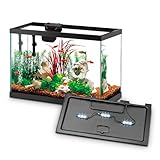

How to Convert Aquarium Feet to Liters
If your tank dimensions are in feet and you want liters, the conversion is direct: multiply length × width × height (in feet) to get cubic feet, then multiply by 28.3168 — the exact number of liters in one cubic foot. Two caveats matter: the dimensions you enter (outer vs inner) and the difference between nominal and actual water volume (glass, rim gap, substrate). This guide gives the formula, the corrections, and a quick-reference for standard tank sizes.
The Formula (Liters)
Volume (ft³) = L × W × H          (all in feet)
Liters       = Volume (ft³) × 28.316846592

Combined: Liters = L × W × H × 28.3168

Example: 6 × 2 × 2 ft tank
  Volume  = 6 × 2 × 2 = 24 ft³
  Liters  = 24 × 28.3168 ≈ 679.6 L
28.316846592 is the exact conversion (1 ft = 0.3048 m, and 1 m³ = 1000 L, both exact by definition). For practical aquarium use, 28.3168 is more than enough precision. The same tank in U.S. gallons is ~179.5 gal; in Imperial gallons, ~149.5 gal.
Liters, U.S. Gallons, and Imperial Gallons
| Unit | Liters | Gallons per ft³ |
|---|---|---|
| Liter (SI-derived) | 1 | 28.316846592 |
| U.S. liquid gallon | 3.78541 | 7.48052 |
| Imperial gallon (UK) | 4.54609 | 6.22883 |
If you work entirely in liters, you can ignore the gallon distinction. If a product label uses gallons, confirm which gallon — U.S. and Imperial differ by ~20%. Liters are the common unit for international products and most medication dosing outside the U.S.
Outer vs Inner Dimensions
The dimensions you measure determine whether the result is outer-tank volume or water volume. Internal water volume is smaller:
inner_length = outer_length − 2 × glass_thickness
inner_width  = outer_width  − 2 × glass_thickness
inner_height = outer_height − glass_thickness (bottom) − rim_gap (typically 1–2 in)

Example: 6 × 2 × 2 ft tank, 1/2" glass, 1" rim gap
  inner_L = 6 − 2 × 0.0417 = 5.917 ft
  inner_W = 2 − 2 × 0.0417 = 1.917 ft
  water_D = 2 − 0.0417 − 0.0833 ≈ 1.875 ft
  Liters  = 5.917 × 1.917 × 1.875 × 28.3168 ≈ 602.9 L

→ about 11% less than the "679.6 L" outer estimate
Typical glass thickness: 3 mm (~0.01 ft) for small tanks; 1/4" (~0.021 ft) for 20–40 gal; 3/8" (~0.031 ft) for 55–75 gal; 1/2" (~0.042 ft) for 90–125 gal. The rim gap is usually 1" (25 mm) for freshwater, sometimes more for reef or open-top setups.
Substrate and Displacement
| Contents | Depth (in) | Volume displaced (L) |
|---|---|---|
| Substrate | 1 | ~56.6 L |
| Substrate | 2 | ~113.3 L |
| Substrate | 3 | ~169.9 L |
| Rock / driftwood | — | ~5–15% additional (highly variable) |
| Internal filter / equipment | — | ~2–5% |
| Water level (1" rim gap) | — | ~28.3 L |
On a 6 × 2 ft tank, 2" of substrate plus a 1" rim gap deducts about 142 liters — a "679.6 L" outer figure becomes ~538 L of actual water before hardscape. This is the number to use for stocking, dosing, and filter sizing. The aquarium volume calculator deducts substrate precisely.
Standard Tank Sizes — Outer and Actual Water
| Dimensions (ft) | Outer liters | Approx. actual water (L) | Typical rated size |
|---|---|---|---|
| 1 × 1 × 1 | 28.3 | ~24–26 | Nano cube (~7 U.S. gal) |
| 2 × 1 × 1.5 | 84.9 | ~72–78 | 20-gallon long (~76 L) |
| 2.5 × 1.5 × 1.5 | 159.8 | ~136–146 | 40-gallon breeder (~151 L) |
| 3 × 1.5 × 1.5 | 191.1 | ~163–175 | 50-gallon (~189 L) |
| 4 × 1.5 × 2 | 339.8 | ~290–312 | 90-gallon (~341 L) |
| 4 × 2 × 2 | 453.1 | ~390–420 | 120-gallon (~454 L) |
| 6 × 2 × 2 | 679.6 | ~530–580 | 180-gallon (~681 L) |
| 8 × 2 × 2 | 906.1 | ~720–780 | 240-gallon (~908 L) |
"Actual water" assumes 1/2" glass, 1" rim gap, 2" substrate, and light hardscape. Individual tanks differ; the manufacturer's spec sheet is authoritative for a specific model. Note that a "20-gallon" U.S. tank is ~76 L — do not confuse the U.S. gallon rating with liters.
Other Tank Shapes
| Shape | Formula | Notes |
|---|---|---|
| Rectangle | L × W × H × 28.3168 | Base case |
| Cylinder | π × r² × H × 28.3168 | r = inner radius; D/2 where D is inner diameter |
| Bowfront | L × W × H × 28.3168 × 0.85 | 0.85 is a conservative approximation — bowfront holds 10–20% less than its outer box |
| Regular hexagon | 2.598 × S² × H × 28.3168 | S = side length |
| Corner (right triangle) | (L × W / 2) × H × 28.3168 | For triangular footprints |
For irregular tanks, use the fill-and-measure method: fill the tank with a known volume (e.g., a 5-L or 10-L bucket, counted), marking each addition until full. Slower but exact. Or use the manufacturer's stated volume from the specification sheet.
Why the Difference Matters
- Dosing: conditioners, medications, and fertilizers are dosed per liter — using outer volume over-doses by 15–25%.
- Stocking: bioload limits are based on actual water volume. See the stocking calculator.
- Filtration: filters are rated in liters per hour; you want 4–8× actual water volume per hour. See the filter size calculator.
- Heaters: heaters are dosed at ~0.75–1.3 W per liter of actual water (~3–5 W per U.S. gal). See the heater size calculator.
Related Tools
- Aquarium volume calculator — with substrate deduction
- Feet to gallons — the U.S. gallon equivalent of this page
- Dimensions to gallons (inches) — for inch input
- Gallon to liter — unit conversion
- Liter to gallon — reverse conversion
- Tank weight calculator — floor loading
- Substrate calculator — depth and bag count
Frequently Asked Questions (Feet to Liters)
How accurate is this volume calculator?
The arithmetic is exact: ft³ × 28.3168 = liters. The accuracy of the result depends
on whether the dimensions you enter are outer or inner, and on what will occupy the tank (glass, substrate,
hardscape). For a general estimate, the outer-volume figure is fine; for stocking or dosing, use actual
water volume.
Can I convert liters to gallons?
Yes. Divide liters by 3.78541 for U.S. liquid gallons, or by 4.54609 for Imperial gallons. The reverse: multiply liters by 0.264172 for U.S. gallons, or by 0.219969 for Imperial gallons.
How do I convert liters to U.S. or Imperial gallons?
Liters → U.S. gallons: divide by 3.78541. Liters → Imperial gallons: divide by 4.54609. Example: 200 L is ~52.8 U.S. gal or ~44.0 Imperial gal.
Why use feet instead of inches?
Feet are convenient for larger tanks and for measurements taken with a tape. For inch input, use the dimensions to gallons (inches) tool — it uses the same conversion logic. Decimal feet (e.g., 2.5 ft) work in this calculator.
What if I have a rimless tank?
Rimless tanks are often filled closer to the top — the rim gap may be smaller or near zero. Adjust the water depth accordingly. For a nano tank (~30 L) with a 2.5 cm gap, deduct 1–2 L; for a large tank (>500 L) with a 2.5 cm gap, deduct 5–10 L. Percentage-wise, the deduction is larger on small tanks.
Does glass thickness affect the result?
Yes — if you measure outer dimensions. Subtract twice the glass thickness from length and width, and once (plus rim gap) from height. For a 6 × 2 × 2 ft tank with 1/2" glass and 1" rim gap, outer volume (679.6 L) becomes ~603 L of inner-tank water.
How do I get actual water volume?
Start with the inner-tank volume (see glass-thickness section). Then subtract substrate (depth × footprint × 28.3168), hardscape (5–15% estimate), and equipment (2–5%). On a 6 × 2 × 2 ft tank, 2" substrate plus a 1" rim gap removes ~142 L, leaving ~538 L before hardscape.
Is this calculator a substitute for the manufacturer's specification?
No. The manufacturer's spec sheet gives exact dimensions, glass thickness, and rated volume for a specific model. Use this calculator for a general estimate or to check a spec sheet — but for stocking or dosing, rely on measured (or spec-sheet) actual water volume. Related tools: volume calculator, feet to gallons, gallon to liter.
Sources and references
- NIST — SP 811: Guide for the Use of the International System of Units (SI)
- BIPM — The International System of Units (SI Brochure), definition of the liter
- OATA — Ornamental Aquatic Trade Association husbandry guidance
- Manufacturer dimension and volume specifications — Aqueon, Seapora, Waterbox