Aquarium Electricity Cost Calculator: Calculate Your Aquarium's Power Consumption
Calculate the electricity cost of running your aquarium by entering your equipment's power usage and your local electricity rate. This tool will help you estimate how much it costs to operate your aquarium each month.
List of the Best Aquarium:


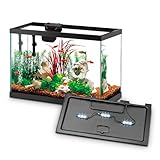

How to Calculate Aquarium Electricity Cost
The formula is simple: kWh = watts × hours ÷ 1,000, and cost = kWh × rate. The complication is that each device runs a different number of hours — a filter runs 24/7, lights run 6–10 hours, and a heater runs intermittently (its "duty cycle"). Using one uniform hours figure — the most common mistake — overstates heater cost in summer and understates it in winter. This guide calculates each device separately, which is how you get a bill-matching estimate.
The Formula (Per Device)
Monthly kWh per device = (watts × hours_per_day × 30) ÷ 1,000
Monthly cost per device = kWh × electricity_rate

Total monthly cost = sum of all device costs
This is the correct structure — per device, then sum. If you enter a single "total wattage" for all equipment and one "average hours" figure, the result will be wrong for any tank whose devices run different schedules (which is almost every tank).
Heater Duty Cycle — the Largest Source of Error
A 200 W heater does not draw 200 W × 24 h every day. It cycles on and off to maintain tank temperature. The fraction of time it is on is the duty cycle, which depends on:
- Room temperature vs tank setpoint — the larger the gap, the longer the heater runs
- Season — winter duty cycle is typically 40–70%, summer 10–30% in a heated home
- Tank insulation — glass lids, foam wrap, and covered sumps reduce heat loss
- Tank volume and surface area — larger surface area = more heat loss = higher duty cycle
Practical rule: use an average duty cycle of 40–50% for a temperate-climate indoor tank; 20–30% if your home is warm; 60–75% in a cool basement in winter. Using a full 100% (24 h) will overstate heater cost by 2–5×.
Worked Example — Per-Device Calculation
55 gal tank, electricity rate $0.12/kWh, heater duty cycle 40%:
Heater:  200 W × (24 h × 0.40 = 9.6 h) × 30 ÷ 1,000 = 57.6 kWh → $6.91/mo
Filter:   20 W × 24 h × 30 ÷ 1,000                 = 14.4 kWh → $1.73/mo
Lights:   50 W ×  8 h × 30 ÷ 1,000                 = 12.0 kWh → $1.44/mo
Air pump: 10 W × 24 h × 30 ÷ 1,000                 =  7.2 kWh → $0.86/mo

Total monthly kWh = 91.2
Total monthly cost = $10.94
Compare to the "one big total" method (280 W × 12 h × 30 ÷ 1,000 = 100.8 kWh = $12.10) — the simpler calculation is off by about 11%, and can be off much more depending on the heater duty cycle and seasonal effects.
Typical Equipment Wattage and Run Hours
| Equipment | Typical watts | Typical run hours/day | Notes |
|---|---|---|---|
| Heater | 50–300 W | Intermittent — duty cycle 20–75% | Depends on room temperature, season |
| HOB / canister filter | 5–25 W | 24 h | Continuous |
| LED lights (low-tech) | 10–30 W | 6–8 h | Timer-controlled |
| LED lights (planted) | 30–100 W | 8–10 h | Timer-controlled |
| T5 / T8 fluorescent | 20–60 W per tube | 8–10 h | ~40–60% more energy than LED |
| Air pump | 2–10 W | 24 h | Continuous |
| Powerhead / circulation pump | 3–15 W | 24 h | Continuous |
| CO2 solenoid | 2–5 W | 8–10 h | CO2 itself does not consume electricity; the solenoid controls flow |
| pH controller | 3–10 W | 24 h | Continuous — monitors pH |
| UV sterilizer | 5–25 W | 8–24 h | Often run 8–12 h/day |
Values are typical ranges — check your equipment labels for exact wattage. Heater wattage is usually higher than other devices; in most tanks, it is the single largest consumer, but only because of its duty cycle, not because it runs all day.
Typical Monthly Cost by Tank Size
| Tank size | Typical total watts | Monthly kWh | Cost @ $0.12/kWh | Cost @ $0.20/kWh |
|---|---|---|---|---|
| 10 gal | ~40 W | ~15 kWh | ~$1.80 | ~$3.00 |
| 20 gal | ~80 W | ~30 kWh | ~$3.60 | ~$6.00 |
| 55 gal | ~280 W | ~90 kWh | ~$10.80 | ~$18.00 |
| 75 gal | ~350 W | ~120 kWh | ~$14.40 | ~$24.00 |
| 125 gal | ~550 W | ~180 kWh | ~$21.60 | ~$36.00 |
Values assume moderate-light tanks, heater duty cycle 40%, LEDs, and 24/7 filtration. US average residential rate is around $0.12–$0.20/kWh per U.S. EIA (2024). High-cost regions (California, Hawaii, New England) can run 1.5–2× higher; hydro-heavy regions (Pacific Northwest) can run lower.
Reducing Aquarium Electricity Cost
- Switch to LED lighting: LED vs T5/T8 fluorescent saves 40–60% on lighting electricity for the same light output.
- Lower tank temperature slightly: each 1 °F reduction (within the species-safe range) reduces heater energy by ~3–5%, because heat loss is proportional to the tank–room temperature difference (DOE Energy Saver).
- Cover the tank: glass lids and foam wrap reduce evaporation and heat loss, cutting heater duty cycle.
- Insulate the room, not just the tank: a warmer room means a lower heater duty cycle. Insulating the room has the side benefit of lowering heat cost year-round.
- Run lights on a timer: 6–8 hours is enough for most low- and medium-light tanks; 8–10 hours for high-tech planted.
- Size the heater correctly: an oversized heater cycles on/off more often and may not run efficiently; a properly sized heater (3–5 W per gallon) runs at a steadier duty cycle.
- Use a pump only when needed: powerheads and UV sterilizers can run on timers if the tank has adequate baseline flow.
- Time-of-use rates: if your utility charges peak/off-peak rates, running lights and UV during off-peak hours saves real money even at the same kWh.
What the Calculator Does Not Capture
- Seasonal variation — heater duty cycle in summer vs winter can differ by 30–50%.
- Duty cycle — you must estimate this from room temperature and tank setpoint.
- Power factor — small effect for typical aquarium equipment; the meter measures watts, which is what utilities bill.
- Utility rate structure — flat vs time-of-use vs demand changes the effective rate.
- Standby draw — most aquarium equipment has negligible standby draw; excluded.
Related Tools
- Heater size calculator — correct heater wattage
- Light wattage calculator — lights by tank size
- Filter size calculator — flow and power
- Volume calculator — tank water volume
- Dosage calculator — product dosing
Frequently Asked Questions (Aquarium Electricity Cost)
How much will it cost to run my aquarium per month?
Typical ranges: 10 gal ~$1.50–$3, 20 gal ~$3–$6, 55 gal ~$9–$18, 75 gal ~$12–$24, 125 gal ~$18–$36 per month (US rates $0.12–$0.20/kWh). Your actual cost depends on heater duty cycle, room temperature, tank coverage, and your local rate. Use the calculator above for a per-device estimate.
Why is my actual cost different from the calculator?
Four common reasons: (1) the heater duty cycle differs from your assumption; (2) the utility rate changes with season, time-of-use, or tiered pricing; (3) some devices run fewer or more hours than you entered; (4) you might be including standby draw that the calculator excludes. The per-device method usually lands within 10–20% of the true bill.
Does heater duty cycle matter?
Enormously. A 200 W heater at 40% duty cycle costs ~$7/month; at 100% it costs ~$17/month — nearly 2.5× more. Duty cycle depends on room temperature, season, and tank insulation. Use your room temperature and tank setpoint to estimate (see "Heater Duty Cycle" above).
What is a kilowatt-hour (kWh)?
A kWh is the energy used by a 1,000 W device running for one hour. Your utility bills per kWh — check your recent bill for the exact rate. Common US residential rates in 2024: ~$0.12–$0.20/kWh (EIA).
Should I use rated watts or average watts?
Use the nameplate rated watts (e.g., 200 W heater), then apply the duty cycle for hours (e.g., 9.6 h = 24 × 0.40). For continuous devices (filter, air pump), use rated watts × 24 h. For lights, use rated watts × the timer hours. Do not use "average watts" figures from product marketing unless they specify the condition.
Can I save electricity by reducing the hours my equipment runs?
For lights and UV sterilizers, yes — reduce hours. For filters, do not — continuous filtration is required for biological health. For heaters, hours are not directly controllable; duty cycle is affected by room temperature and tank coverage. Consider LEDs, a tank cover, and a slightly lower setpoint within species-safe range.
Is this calculator a substitute for a bill estimate?
No. It computes kWh and cost from your inputs. For exact costs, use a plug-in energy meter on individual devices, or check your utility bill against a period when you ran the aquarium at a known schedule. Related tools: heater size calculator, light wattage calculator, filter size calculator.
Sources and references
- U.S. DOE — Energy Saver: Estimating Appliance and Home Electronic Energy Use
- U.S. EIA — Electric Power Monthly: residential electricity price data
- ENERGY STAR — aquatic equipment and appliance criteria
- OATA — Ornamental Aquatic Trade Association husbandry guidance